
Running a dental practice takes more than clinical care. Every day, dental teams are managing...
Read More
Patient Retention Guide
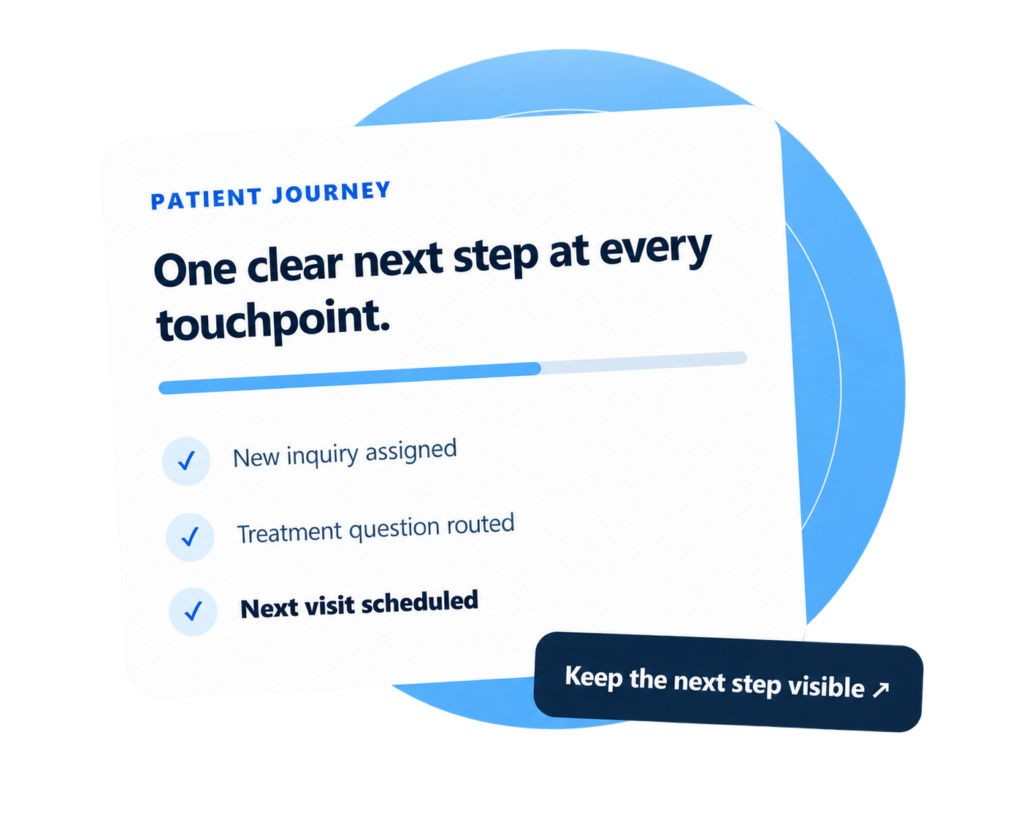
A patient calls but does not book. Another leaves with recommended treatment and plans to “think about it.” A hygiene patient reaches the end of a visit without scheduling the next one. None of these moments looks like a major problem on its own. Together, they can leave a dental practice with a growing list of patients who intended to return but never took the next step.
Dental practices often lose momentum in the space between patient interactions. The team provides excellent care during the appointment, but calls, questions, scheduling, and follow-up compete for attention afterward. Those gaps can become a dental patient retention problem when nobody owns the next step and an interested patient quietly becomes an inactive one.
Here is where that momentum commonly slows and how to build a more dependable follow-up process.
THE PATIENT JOURNEY
Where momentum slips
First inquiry
Call or form
Treatment
Decision pending
Insurance
Question unresolved
Appointment
Visit not confirmed
Recall
Next visit unbooked
Where momentum slips
In this context, momentum is a patient’s progress from one clear step to the next: inquiry to appointment, consultation to treatment decision, visit to future care. A practice loses momentum when a patient is willing to continue but the handoff is delayed, unclear, or never completed.
That does not mean every unbooked patient was lost because the team failed to call. People may change priorities, seek care elsewhere, or decide against a recommendation. The goal is to remove avoidable gaps, give patients the information they need, and make it easy to reconnect when they are ready.
Patient moment |
What can stall |
A useful next step |
|---|---|---|
New inquiry |
A call or form request receives no timely response |
Assign an owner and record the outcome |
Treatment recommendation |
The patient leaves with unanswered questions |
Document the concern and agree on a follow-up plan |
Insurance question |
An estimate is treated as a coverage guarantee or never clarified |
Route the question for verification and update the patient |
Appointment |
The patient cancels or does not confirm |
Offer an appropriate rescheduling path |
Hygiene recall |
No next visit is booked and the patient becomes overdue |
Contact the patient according to the practice's recall process |
Patient moment: New inquiry | |
|---|---|
What can stall: |
A call or form request receives no timely response |
A useful next step |
Assign an owner and record the outcome |
Patient moment: Treatment recommendation | |
|---|---|
What can stall: |
The patient leaves with unanswered questions |
A useful next step |
Document the concern and agree on a follow-up plan |
Patient moment: Insurance question | |
|---|---|
What can stall: |
An estimate is treated as a coverage guarantee or never clarified |
A useful next step |
Route the question for verification and update the patient |
Patient moment: Appointment | |
|---|---|
What can stall: |
The patient cancels or does not confirm |
A useful next step |
Offer an appropriate rescheduling path |
Patient moment: Hygiene recall | |
|---|---|
What can stall: |
No next visit is booked and the patient becomes overdue |
A useful next step |
Contact the patient according to the practice's recall process |
The first call is a small but important handoff. A prospective patient may want to know whether the practice is accepting new patients, whether a particular appointment is available, or whether someone can explain insurance and payment options. If the phone goes unanswered or a web inquiry sits without an owner, that person may never get enough information to make a decision.
Make every new inquiry a trackable item. Capture how the patient contacted you, the reason for the request, the best contact method, who will respond, and whether an appointment was made. If the patient is not ready to book, record the question or obstacle instead of marking the inquiry as simply “closed.”
The person responding does not need to deliver a sales pitch. A useful response answers the immediate question, explains what the practice can do next, and makes booking straightforward. For more detail on call conversations, see our dental practice phone etiquette guide.
Patients have legitimate reasons to wait before scheduling treatment. They may need to consider the dentist’s recommendation, review the cost, arrange time off, or speak with family. The problem arises when the practice cannot tell which patients are considering treatment, which have declined, and which are waiting for a question to be answered.
At the end of a treatment conversation, document the recommended next step and the patient’s stated concern in the approved record. If they want more time, ask whether and how they would like the team to follow up. The person who later contacts the patient should be able to see the relevant administrative context without guessing what was said chairside.
Follow-up should help a patient decide, not pressure them into treatment. An administrative teammate can help with scheduling and approved cost information. Questions about clinical risks, alternatives, or whether care can wait belong with the clinician. A separate guide on unscheduled treatment plans can explore outreach wording and timing in more detail.
Insurance uncertainty can pause a patient’s decision even when they understand the recommended care. They may be waiting for eligibility information, benefit details, an estimate, or an explanation of a balance. A rushed answer can create a different problem if it sounds like a promise of payment by the insurer.
Set a clear handoff: record the specific question, identify who will review it, and tell the patient how they will receive an update. Keep eligibility and benefit verification separate from any guarantee of reimbursement. When the answer arrives, note that the patient was contacted and whether they need another step, such as scheduling or a conversation with the clinician.
If this work regularly gets stuck between the front desk and billing team, DentVia’s dental insurance verification services can support the administrative review. The practice still sets its communication and escalation rules.
A cancellation does not have to be the end of a patient’s care plan. Yet if the original appointment is removed and no rescheduling task is created, the patient can disappear from the active schedule. An unanswered reminder can leave the team uncertain whether the patient plans to attend.
Give the team a simple process for each outcome. When someone cancels, offer appropriate alternatives and record whether the patient booked another date or wants a later contact. When a patient does not confirm, follow the practice’s reminder and escalation policy rather than assuming they will or will not arrive. The American Dental Association’s appointment-confirmation guidance discusses confirmation practices and follow-up for patients who tend to miss appointments.
Measure the result of the contact, not just whether a reminder was sent. The useful question is whether the appointment was confirmed, moved, canceled, or still needs attention.
After a visit, patients often expect to return for hygiene or another recommended appointment. Time passes quickly when the next visit is not scheduled and there is no clear recall workflow. A patient who intended to return can become overdue without ever making an explicit decision to leave the practice.
Before the patient leaves, explain the recommended next visit and offer to schedule it when appropriate. If it cannot be booked then, record when the team should reach out, the preferred contact method, and any relevant scheduling limitations. Keep overdue lists current so completed appointments and patients who have asked not to be contacted do not remain in the outreach queue. The ADA’s guidance on recare appointments also emphasizes arranging the next visit rather than leaving it indefinitely open.
List cleanup, messaging, and outreach cadence deserve their own detailed guide. Here, the essential principle is ownership: someone must know which patients need a recall contact and how to close the loop.
The issue is rarely that one person does not care. More often, the task lives between roles. The assistant thinks the front desk will call. The front desk assumes the treatment coordinator has the list. A question is recorded in one place while the callback task is kept somewhere else. When the day gets busy, work with no named owner falls behind.
A basic follow-up workflow should answer five questions:
Keep patient communication preferences and privacy requirements in the process. For voicemail, text, and other outreach, staff should follow practice policy and the patient’s stated preferences. The ADA’s HIPAA communication guidance advises discretion with reminders that other people might see or hear.
You do not need a complicated dashboard to spot dental patient retention gaps. Review a small sample of recent inquiries, unscheduled treatment plans, canceled appointments, and overdue hygiene patients. Look for items without a clear owner or documented outcome.
Useful questions include:
These are workflow checks, not performance promises. Start with what your existing systems can show. If you notice a recurring bottleneck, fix the handoff before adding more reminders or more outreach volume.
THE TAKEAWAY
Dental practice momentum is built one handoff at a time. A patient should know who will respond, what happens next, and how to take the next step when they are ready. The practice needs the same clarity behind the scenes.
If your onsite team has the process but not enough time to carry it out consistently, DentVia’s virtual dental receptionist support can help with approved calls, scheduling, appointment confirmations, new patient follow-up, hygiene recall, and unscheduled treatment outreach. DentVia’s trained remote team works within your practice’s instructions, while your clinicians retain clinical decisions and your practice remains responsible for the patient relationship.
There is no single reason. Some patients choose not to return, while others face practical barriers such as scheduling, cost questions, or uncertainty about the next visit. Practices can address avoidable gaps by clearly assigning and documenting patient follow-up.
Patient follow-up is a specific action after an inquiry, visit, recommendation, or missed appointment. Dental patient retention describes whether people continue receiving care from the practice over time. Consistent, helpful follow-up supports retention, but it cannot guarantee that every patient returns.
That depends on the request. Front desk or remote reception staff can handle approved scheduling and routine outreach; insurance specialists can review benefits questions; clinicians should address clinical concerns. Every item needs a named owner and a documented handoff.
Start by sorting requests by type, assigning owners, and recording outcomes in one approved workflow. Then decide which routine calls and scheduling tasks can be supported by trained staff outside the onsite front desk, with clear escalation rules.
When your in-office team is juggling patients, scheduling, and incoming calls, trained remote reception support can help keep the phone experience consistent with your practice’s instructions.
Running a dental practice takes more than clinical care. Every day, dental teams are managing...
Read MorePatient Retention Guide Why Dental Practices Lose Momentum The small gaps between calls, treatment decisions,...
Read MoreRunning a dental practice is rewarding, but the administrative side can quickly become overwhelming. Between...
Read More