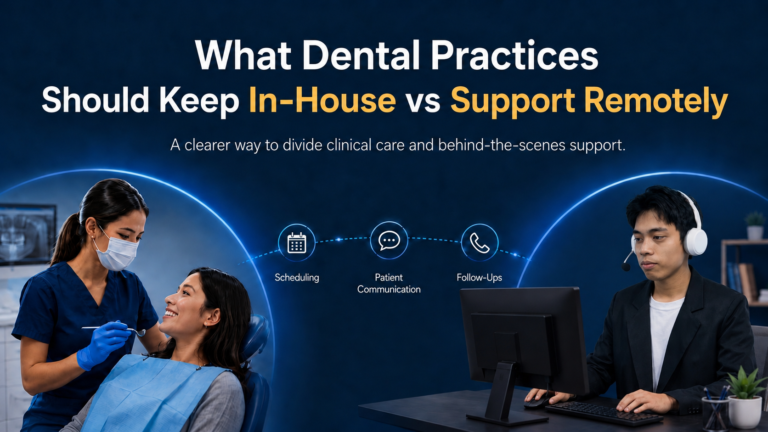
Running a dental practice takes more than clinical care. Every day, dental teams are managing...
Read More
DENTAL BILLING GUIDE
Dental billing directly affects how reliably a practice turns completed treatment into collected revenue. Yet in many offices, billing must compete with patient calls, scheduling, check-in, insurance questions and everything else happening at the front desk.
Claims may get submitted, but follow-up becomes inconsistent. Denials sit unresolved. Aging balances receive attention only when someone finds a quiet afternoon, which does not happen often in a busy dental practice.
Outsourced dental billing gives these responsibilities a dedicated place in the practice workflow. Instead of asking an already-busy onsite employee to manage every step, the practice assigns specific billing duties to trained remote specialists.
That can create more consistent support, but outsourcing is not automatically right for every dental practice. The decision depends on your workload, internal expertise, systems, communication needs and the responsibilities you want an outside team to handle.
Outsourced dental billing is an arrangement in which a dental practice assigns some or all of its administrative billing responsibilities to an external billing team.
Outsourced support may include:
The dental practice remains responsible for clinical decisions and the accuracy of its treatment records and documentation. The billing partner works from the information provided by the practice and follows the procedures established during onboarding.
Outsourcing does not have to mean handing over the entire billing operation. A practice may outsource only part of the workload while keeping other responsibilities in-house.
For example, the onsite team might retain treatment-plan discussions and collect payments at checkout, while a remote specialist handles claim submission, insurance follow-up and accounts receivable activity.
The exact process varies by practice and provider, but an effective arrangement begins with clearly defining the workflow and each team’s responsibilities.
Review the Workflow
Review the software, payer mix, billing procedures, reports, documentation requirements and communication preferences.
Assign Responsibilities
Determine which claims, accounts and follow-up duties are included and what must return to the onsite team.
Begin Billing Work
The remote team completes the agreed work using the practice’s approved systems and procedures.
Report and Escalate
Completed work is documented, while missing information and items requiring approval are communicated.
A clear division of responsibility prevents duplicated work and helps keep important tasks from falling between teams.
The exact process varies by practice and provider, but an effective arrangement begins with clearly defining the workflow and each team’s responsibilities.
More Consistent Follow-Up
Outstanding claims can be tracked, payer responses documented and appropriate next steps followed.
Greater Attention to A/R
Aging insurance and patient balances can receive a consistent review process.
Less Front-Desk Pressure
Defined billing duties no longer have to compete with every immediate patient-facing demand.
Additional Capacity
Remote billing can add support without requiring another onsite desk or workstation.
Staffing Continuity
A documented workflow can reduce dependence on one onsite employee’s availability.
Submitting a claim is only one stage of the billing process. Claims can be rejected, delayed, denied or returned with requests for more information.
Electronic claims must pass a series of format and processing checks. The Centers for Medicare & Medicaid Services explains that claims containing certain errors may be rejected for correction or denied during processing.
Although procedures vary among payers, the broader lesson is the same: claims need to be monitored after submission.
“Claims need to be monitored after submission.”
DENTVIA DENTAL BILLING GUIDE
Accounts receivable can grow when outstanding balances do not receive regular review. This does not necessarily mean the practice is poorly managed. In many cases, the team simply has too many immediate patient-facing demands.
Outsourced support can give aging insurance and patient balances a consistent review process. Accounts can be prioritized according to the practice’s procedures, and issues requiring internal action can be brought to the onsite team’s attention.
A front-desk employee may be responsible for calls, patients, appointments, insurance information, payments and billing during the same workday. Each interruption forces that employee to shift attention.
Moving defined billing responsibilities to a remote specialist can allow the onsite team to focus more closely on patients and immediate office operations.
A growing practice may need more billing support without having the space or operational need for another employee inside the office. Remote billing can add administrative capacity without requiring another onsite desk, computer or workstation.
Billing knowledge can become concentrated in one employee. When that person is absent or leaves the practice, claim follow-up and account history may become difficult for someone else to continue.
A documented outsourced workflow can provide additional continuity during staffing changes. It does not eliminate the need for oversight or internal knowledge, but it can reduce dependence on one onsite employee’s availability.
Outsourcing has tradeoffs, and practices should examine them before choosing a provider.
Remote Communication
A reliable process is needed for missing information, approvals and urgent questions.
Clear Responsibilities
Undefined ownership can lead to duplicated work or overlooked accounts.
Sensitive Information
Access controls, training, safeguards and contractual protections require review.
Practice Oversight
Leadership should continue reviewing reports and understanding the revenue cycle.
A remote specialist cannot perform physical front-office duties or speak with the dentist face-to-face whenever a question arises. The practice needs a reliable method for communicating missing information, obtaining approvals and escalating issues.
If the practice assumes the billing provider is handling an account while the provider believes it remains with the front desk, that account may receive no attention. Tasks, approvals, escalation rules and reporting expectations should be established before work begins.
Dental billing may involve access to protected health information. The U.S. Department of Health and Human Services identifies billing and claims processing as activities that can make a vendor a business associate. HHS also explains when a business associate agreement, or BAA, is required.
A practice should ask how access is controlled, where work is performed, how team members are trained and what safeguards protect patient information.
The owner or a designated team member should still monitor aging accounts, collections, denials, unresolved claims and items awaiting practice action. The outside team provides support, but practice leadership retains responsibility for the overall operation.
The cost of outsourced dental billing depends on the provider, staffing model, workload and services included.
Hourly
Based on time worked
Monthly
Fixed recurring fee
Percentage
Based on collections
Per Claim
Based on claim volume
When comparing outsourced and in-house billing, a practice should look beyond an employee’s hourly wage. In-house costs may also include recruiting, onboarding, payroll taxes, benefits, training, management time, equipment and coverage during absences or turnover.
The practice should also examine what is included in each outsourced proposal. One provider may perform only claim submission, while another may also support denials, appeals, accounts receivable, patient ledgers and billing communication.
The least expensive proposal is not necessarily the lowest-cost option if important responsibilities remain uncovered.
Practices considering DentVia can review its current virtual assistant pricing and discuss the hours and billing responsibilities required for their workflow.
Neither option is universally better. The right model depends on the practice’s needs, resources and existing team.
Consideration |
Outsourced billing |
In-house billing |
|---|---|---|
Location |
Work is performed remotely |
Employee works inside the practice |
Recruiting |
Provider supplies remote billing personnel |
Practice recruits and hires |
Workspace |
No additional onsite workstation is needed |
Office space and equipment are required |
Daily focus |
Assigned billing work receives dedicated attention |
Billing may compete with patient-facing duties |
Physical support |
Cannot perform onsite tasks |
Can help with physical front-office work |
Communication |
Requires a defined remote process |
Direct in-person communication is available |
Management |
Shared between provider and practice |
Managed entirely by the practice |
Outsourced billing | |
|---|---|
Location |
Work is performed remotely |
Recruiting |
Provider supplies remote billing personnel |
Workspace |
No additional onsite workstation is needed |
Daily focus |
Assigned billing work receives dedicated attention |
Physical support |
Cannot perform onsite tasks |
Communication |
Requires a defined remote process |
Management |
Shared between provider and practice |
In-house billing | |
|---|---|
Location |
Employee works inside the practice |
Recruiting |
Practice recruits and hires |
Workspace |
Office space and equipment are required |
Daily focus |
Billing may compete with patient-facing duties |
Physical support |
Can help with physical front-office work |
Communication |
Direct in-person communication is available |
Management |
Managed entirely by the practice |
Some practices use a hybrid arrangement. They keep patient-facing financial conversations and certain decisions in-house while assigning claims, follow-up or accounts receivable work to a remote team.
A practice may be ready to consider outsourced dental billing when important work is repeatedly falling behind.
These signs do not automatically mean every billing responsibility should be outsourced. The practice might need ongoing billing support, temporary help with a backlog or a clearer division of responsibilities between onsite and remote team members.
Before selecting a provider, ask questions that reveal how the working relationship will operate day to day.
Outsourced dental billing is most useful when it solves a clearly defined operational problem.
If claims, denials and aging balances already receive consistent attention from an experienced in-house team, replacing that system may offer little value. If billing regularly falls behind because the same employees are also responsible for patients, calls and scheduling, dedicated remote support may be worth considering.
Before deciding, identify which responsibilities are falling behind, why the delays are happening and which duties must remain in-house. Then compare the complete cost, scope and communication process of each option.
That provides a better basis for making the decision than comparing hourly rates alone.
Services vary by provider. Support may include claim preparation and submission, claim-status follow-up, denial review, corrected claims, appeals, accounts receivable, patient ledgers and billing communication.
No. Dental billing is one part of the broader revenue cycle. Billing generally focuses on claims, payments, denials and outstanding balances. Dental revenue cycle management considers the wider financial process.
Yes. A practice can assign selected responsibilities to an outside team while keeping other duties in-house. Clearly defined task ownership is essential.
Not necessarily. DentVia’s remote billing specialists work within the systems already used by the dental practice, subject to compatibility and approved access established during onboarding.
Security depends on the provider’s systems, facilities, training, access controls and procedures. Practices should evaluate these safeguards and establish the appropriate agreements before providing access.
Running a dental practice takes more than clinical care. Every day, dental teams are managing...
Read MorePatient Retention Guide Why Dental Practices Lose Momentum The small gaps between calls, treatment decisions,...
Read MoreRunning a dental practice is rewarding, but the administrative side can quickly become overwhelming. Between...
Read More